3filers, current period
1the period before
26controls it touches
16frameworks
The long view
Filings containing this phrase, every month since 2008. The last
point is the current month and is still filling, so it always looks lower than it will be.
2008
peak 2 in May 2024
2026
The long view
Filings containing this phrase, every month since 2008. The last
point is the current month and is still filling, so it always looks lower than it will be.
2008
peak 12 in February 2024
2026
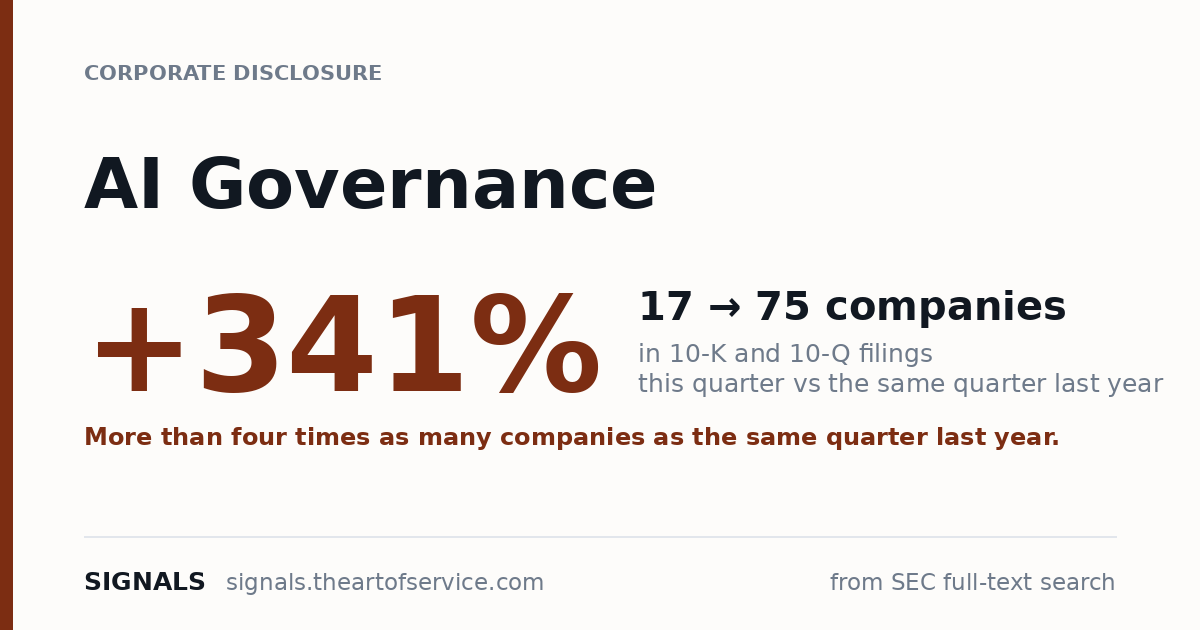
In annual and quarterly filings the same phrase appears 75 times this quarter, up from 17. A 10-K moves slowly: a company changing what it writes there has changed its mind about what is material, rather than reacting to one event.
Share this finding
The card carries the whole thing, so it makes sense to somebody who never clicks through.
That is the point of it.
Who disclosed it
From SEC full-text search over 8-K filings. Every row links to the filing itself.
| Company | Form | Filed | |
|---|
| ServiceNow, Inc. NOW | 8-K | 2026-07-22 | filing |
| SharonAI Holdings Inc. | 8-K | 2026-07-23 | filing |
| VALLEY NATIONAL BANCORP | 8-K | 2026-07-23 | filing |
The full search on EDGAR
How it actually arrives
An 8-K's meaning is in its item number, not its text. These are the items the filings
containing this phrase were filed under. The first group is something that happened to the
company. The second is the phrase turning up in the ordinary course of reporting, most often in
an earnings release, which is a very different thing and is usually the larger number.
| Filed because something happened |
Companies |
|---|
| Other material event Item 8.01 | 7 |
| Director or officer departure Item 5.02 | 6 |
| Mentioned in routine reporting |
Companies |
|---|
| Financial statements and exhibits Item 9.01 | 37 |
| Results of operations, the earnings release Item 2.02 | 18 |
| Regulation FD disclosure Item 7.01 | 17 |
| Entry into a material agreement Item 1.01 | 8 |
| Completion of an acquisition Item 2.01 | 1 |
This is why a headline count on its own overstates the case.
Where the routine number dominates, the phrase is being tracked as language rather than as
events.
Which industries file it
Companies grouped by the industry classification on their own filing. A count, not a
survey.
| Industry | | Companies |
|---|
| Software and IT services | | 17 |
| Banking | | 6 |
| Industrial machinery | | 3 |
| Holding and investment offices | | 2 |
| Mining and extraction | | 1 |
| Not classified | | 1 |
| Pipelines and communications | | 1 |
| Professional and social services | | 1 |
| Real estate | | 1 |
| Retail | | 1 |
What it obligates
Our corpus holds 26 controls across
16 frameworks whose text speaks to this. Not a judgement:
these controls say so, and each is one lookup from its source document. Ordered by how much each
framework has to say about it, so the one that will cost you the most work is first. Every name
opens that framework in the corpus.
What an auditor will ask you to produce
The artefacts named on those controls, most frequently cited first.
- Pipeline + emerging risk readiness
- International framework alignment
- Sectoral exercises + supervisory engagement
- SPM compliance + sectoral engagement
- IFC positioning + competitive analysis
- Strategic initiatives readiness
- IEEE 7000-2021 applicability assessment + system scope + ethical concern relevance per project
- Value-Based Engineering process adoption + organisational charter + integration with system engineering
How it usually fails
Recorded when each control was verified against its source. This is where programmes
that think they are covered turn out not to be.
- International alignment weak
- Pipeline not tracked
- Sectoral engagement gaps
- Compliance gaps
- IFC positioning weak
- Strategic initiatives lag
Where this comes from
The left half is public record: SEC full-text search over 8-K filings, counted across a
7 day window against the equivalent window before it. You can check
every row.
The right half is ours: 723 frameworks and
20,473 controls, 531 of those frameworks verified against
their source documents, with the auditor evidence and common failure modes recorded control by
control. Controls appear here because their own text names this term.
Today's edition ·
How programmes fail ·
The obligation index